Showing posts with label sustainable food. Show all posts

Sunday, October 12, 2008

Genmai (brown rice) for beginners

Brown rice (whole grain) is a lot more nutritious compared to the white rice. It's rich in Vitamin B and E, Potassium... and fiber. But it has some disadvantages as well.

1. Takes long to cook (it's best to soak brown rice in the water overnight).
2. Takes more to digest (might not be good for kids or when your body is ailing)
3. Got some brown rice-ish odor.....

This half-brown rice solved those problems. As you see in the picture, it's not whole-grain; it looks to me like 40%-grain instead of 100%. Obviously less nutritious than brown rice, but more so than white rice. You can cook just as you cook white rice, and it tastes pretty close (not the same though).

It's a little bit expensive, but worth trying. If you live in California, it shouldn't be difficult find it in Japanese grocery stores.

Sukoyaka Genmai, or 健やか玄米 (I bought 15 lbs bag at about $22)
Nishimoto Trading, Santa Fe Springs, CA USA

Friday, August 15, 2008

Mugicha -Barley tea

I am trying not to buy beverages to reduce my carbon footprint. Beverages need to be transported long way, and need to be refrigerated for sales and consumption. A lot of energy. And then, all these glass/plastic bottles.....

So, alternative solution. For summer, I make barley tea in a big pitcher.
Sugar free, caffeine free, no calories.

Pretty healthy. And not expensive at all.

How does it taste?

Well, as a beer lover, I would say that barley tea tastes like Guinness without alcohol and bubbles. Eerrhh, so basically you took all the good stuff from Guinness!?

Honestly, it might taste weird for the first try. But if you get used to it, you will like it. I like it because I don't have to feel that yukky feeling in my month after I drink sweet drinks.

Direction: Find mugicha or barley tea at Japanese or Asian grocery store. They are usually in bags, so you just have to boil water and throw a bag into it and wait for a couple of hours. Some even don't require the water to be boiled, but I believe tap water tastes better when boiled.

Thursday, July 24, 2008

Super lunch! Bento box

Eating little bit of everything is one of the key philosophies of Japanese cuisine.

For presentation, it requires putting together little bit of everything in a coordinated manner. Beauty: well balanced nutrients intake, enjoyment of eating and aesthetics - it's almost an art.

Bento lunch box (to go) is a simple, daily-life version of little bit of everything. At home, Moms have been making Bento for family.

There are a lot of websites that talk about how to make Bento; authentic(like the pic), casual, fun and Bento for kids! Check them out. Or you will find whole bunch of information just by Googling by "Bento box".

Great alternative for brown bag.

Lunch in a box
Cooking cute
USAlifehacks (Japanese)

Monday, July 21, 2008

Don't ask me what I need to drink

Soda is not sustainable. It's not sustainable for health.....just too much sugar.
It doesn't help reduce GHG emission either. Liquid is not compactible, so it takes space and it's heavy. We need to consume enormous amount of energy to transport so many millions (or more?) of bottles and keep them cold. A top of that, soda is accompanied with so much ice that needs more freezers on duty.

I am growingly annoyed when I go to the restaurants and asked "what would you like to drink?" even before I settle down comfortably! With this timing, I almost have to answer immediately! When I get really annoyed, I say "just water please". What I really mean is "Leave me alone and give me some time to think."

But otherwise, I imagine that many people would answer their favorite soda almost automatically. That means, you have almost automatically and unconsciously entitled yourself for 300Kcal or more extra sugar. To make the matter worse, in many places soda is free to refill.

I understand that drink is money making item for restaurants. And offering less soda might hurt business and might increase complaints from customers.

But really sustainable restaurants should be able to offer other values than soda. Plus, really delicious, tasty food doesn't go along with soda. Soda tastes too junky with good food.

Photo: Tea is an Asian alternative for soda. Tim Riley

Monday, July 7, 2008

Getting children eat vegetables

I did not use processed baby food for my son and tried to cook as much fresh vegetable as I could. But even though, he (2 years old) does not always eat vegetables.

But this works like magic.

He wants more and more of carrots! (carrots are not his favorite food actually)

They are sold in local grocery stores in Japan in variety. I don't seem to find them here.....

They are so effective.

You can use them for other food as well.

Thursday, May 22, 2008

Sushi is not sustainable

This isn't news; world fish stock/supply is depleting.

Blame Sushi.

And I'm not joking.


Japanese eat a lot of fish and seafood; Japan has been importing enormous amount of fish from every part of the globe. Now, with more people in the world choosing seafood over to meat for health reasons or just because they love Sushi, the world is depleting fish stock even faster.

Sushi has traditionally been very high-end food, expensive.

That means fish supply (especially fresh) has been far below the demand if there was no aquaculture involved, at least in Japan. This is the very important rule that we should never have forgotten. However, by accelerating import, Japanese misinterpreted the situation and acted as if the fish supply grew. Sushi got cheaper and became almost like daily food. But it wasn't right. Suppy cannot grow really; we were merely depleting the stock in other parts of the world.

Some fishery and aquaculture is very unsustainable...actually disruptive to the environment. Illegal fishing beyond the boundary is also a problem. But consumers are not well informed about those facts.

I am trying to buy "sustainable" seafood. (Check out Seafood Watch by Monterey Bay Aquarium) And they are expensive! Price is deterimed by the relationship of supply and demand - a classic economic principle. Fish is expensive = supply is limited.

Graphic: World fish import: Japan is purple.

Tuesday, May 13, 2008

Grape leaves for Tempura!

I read an article in a local paper about a family that grows grapes for leaves. According to them, the leaves are so good that they wait for them rather than for the grapes.

I decided I need to try....we have Thompson in our backyard, which is a good kind for leaves, the paper says. So I picked some. Young, soft and thin (almost transparent) ones are good for eating.

Then I realized that the paper didn't have the recipe! I had Google a little. I found a Greek cuisine that rolls ground meat with grape leaves, but I was not going to use meat.


So I decided to deep fry them.


Actually, they were good! Soft yet crunchy and have a hint of sweet....probably grape?


I can't help thinking this should be good for Tempura!

Tempura is one of the Japanese dishes that are difficult to find authentic one. "Cost-effective" Tempuras are unnecessarily fat with coating and overly greasy. That is not Tempura.

The real Tempura needs fresh and tasty ingredients, thin coating, good oil and good frying technique. It's not really a home dish. My product above is pretty miserable compared to the picture here...I had hard time to deal with the thin leaves. I couldn't straighten them easily and they turned brown so quickly. Even though they tasted good, they could be much better! I was envisioning something like the green leaf in this picture.


Well, I need a Tempura chef. I dream of good grape leave Tempura, that is not greasy, just crunchy and light. Arrhh!

If you would like to try your grape leaves, it seems like May is the best season in California. The leaves get too hard in June. Googling some more will take you to some more recipes, or, since the leaves are pretty docile, you could be creative and invent your own dish.

Hurry!

Photo at the bottom: panduh

Friday, April 18, 2008

Brew time! Porter

I am a beginner home beer brewer.

I brew my second batch today: Porter. First batch was Ale.


Beer brewing is pretty fun.


And what I really like with brewing beer is.....I am almost free from beer bottle recycling!


12oz bottles easily pile up in the garage. Collectively they are heavy. With two adults in the house, we have to bring in 100-150 bottles every few of months to the collection center. Loading and unloading is quite some work.

Beer is heavy. The bottles are heavy, the liquid is heavy and not compactable. I have to think how much CO2 emission is associated with drinking beer from bottles throughout the entire life cycle. Distribution. Purchase (stores to home). Home to collection hubs for recycling. Collection hubs to glass recyclers. And then, glass recyclers to.....?

That is a lot of travel. And since the bottles are heavy and not compactable, the mass shouldn't be easy to redue. So I doubt that the entire miles traveled by the bottles would lead to quite some CO2 emission.

By brewing beer at home, I can get out of this loop and initiate small closed loop; keep reusing my own bottles. It makes me feel good!

Not only that, home brewed beer tastes good.

I heard that during gold rush times, people used brew in their community; Germans made German beer, English made English beer......it must have been fun. Beer could be one of the "grow locally, buy locally" products....eerhh...if managed properly, I would have to say.

Thursday, April 17, 2008

Taste bud counts: what babies/kids need to eat

"You are what you eat" can be interpreted "You are what you grew up eating". What you grew up eating is what you will eat throughout your life. It will be difficult to change your eating habit once you are too used to it.

So, what babies and kids eat is really important because it can determine one's health for life.

When my son started solid food, I tried some baby food from stores. After a couple of jars, I decided I couldn't use them any more. I thought they tasted weired. I thought they tasted like processed food, they tasted like jar or plastic (I mean, tasted of the container) even though the products boasted no additives or no preservatives.

What was I sensing in baby food? I don't know exactly.

Probably "taste bud" plays some roles. Taste buds are small structures on the upper surface of the tongue that provide information about the taste of food being eaten. They can identify sweet, sour, salty, bitter and probably one or two more tastes.
Babies are born with certain taste buds and they keep developing as they grow. Especially when introduced to solid food, they develop rapidly. First taste that the kids recognize is "sweet" and that is why they like cookies and stuff. Then gradually, taste buds develope as they are stimulated by variety of tastes.

Taste buds development is very important to become an adult that can eat variety of foods (different kinds of textures and different kinds of tastes). It leads to decent and healthy eating habits. It seems like my tongue senses something subtle in processed food. My nephew can detect MSG in any given dish (obviously it's invisible). We both grew up with what resepective mom cooked.

If taste buds don't develop well, one can end up appreciating only "sweet" and "salty". In that case, she/he might have to depend on junk food. Obesity risk could be very high.

Taste buds development peaks at around 20 years old. So, we would have to hurry to properly develop them in time.

I ended up cooking most of the meals for my son.
But here is another approach...interestingly enough, I found a baby food company named "Taste bud organic baby food". Their baby food is frozen.

Here's what they say:
Our company was founded on the strong belief that introducing babies to real food with interesting, flavorful tastes and textures as early as possible sets the stage for a lifetime of joyful, healthy eating. In addition to the simple pleasure that a child gains from eating and enjoying good food, research has shown that kids’ tastes are formed in their first two years. Those who eat a variety of healthy foods early on grow up to be much healthier eaters overall and have a strong chance of avoiding major health concerns (heart disease, obesity, diabetes) in adulthood.

Wednesday, April 16, 2008

Combating obesity: What is Shokuiku

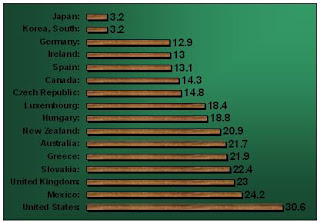
This graph shows obesity statistics by country. (please see the link for details)


You will see the rate is extremely low in Japan (and Korea too).

I believe it is because of what Japanese have been eating. Rice/grain, vegetable, seafood and not much oil/meat.

When it comes to combating obesity, I imagine it will be very tough to try to change eating habits after so many years. I think it is natural for anybody tempted to going back to what she/he's grown up eating. I don't eat much junk food and I am eating less and less meat, but I don't think it's because I am a super-conscious eater. It's more because I didn't grow up eating junk food and a lot of meat. My body is not designed to allow too much intake of those.

So, my assumption for eating is babies/kids' eating habits is extremely important because it virtually determines what you will be in the future. Plus, it's very difficult to retrofit even if something went wrong.

Unfortunately, Japanese young people are eating more and more junk food, and obesity rate is increasing. In reaction, people started to discuss "Shokuiku". It is often translated to "food education" and what it really means is raising awareness of/re-examining eating habit. It is based on the philosophy of "you are what you eat". By carefully choosing what you eat and actively engaged in cooking, the kids will know more how to live health, both physically and mentally.

There were not much materials available in English about Shokuiku. Here is the one. It is directly linked to a pdf file, so the link will prompt you to download it.

What is Shokuiku?

Tuesday, April 15, 2008

Sustainable food: Shiitake

It looks like there are quite some people who come to my blog looking for information about Japanese food.


So....today's topic is Shiitake!


Shiitake is a kind of mushroom that is widely used in Asian countries. It's good to eat, but it's also good for broth.


People usually use dried Shiitake for broth. For several reasons, dried Shiitake produce much better broth than fresh Shiitake. It's also rich in Vitamin D.


With Shiitake broth, the plates can easily be vegetarian and nutritious. Plus, mushroom is very low in calorie. Healthy.


Dried mushroom is easily available at local Japanese/Korean/Chinese grocery stores. Dried are probably more reasonable to buy than fresh Shiitake.

Preparation: Soak dried Shiitakes in water (and not too much water) for hours to overnight. Use broth for soup and Shiitakes themselves are ready for cooking.

My recommendation is to make Shiitake filling for Sushi roll. Dried or fresh.
1) Chop them into pieces (size don't really matter)
2) Stir fry them with oil. (Mushrooms absorb quite some oil, so use enough oil) If you don't want oil, you can boil Shiitake with 3) and a little bit of water.
3) Add soy sauce and white wine (Usually it is Japanese cooking sake, but I substitute it with white wine.) and some sugar.
4) Roll the Sushi, probably with stick a of cucamber or egg.

Another way is to add 3) when you cook rice with rice cooker.


If you are interested in cooking them, Google Shiitake recipe. I found quite some information.

Saturday, April 12, 2008

Mimicking macrobiotic: No.1

Macrobiotic requires some studying or training.

I am not qualified.

So I will try to borrow some ideas and mimic what they do. In this first post, I am going to introduce two items that are commonly used in macrobiotics. Vegan yet very nutritious.

1) Hijiki

This is black, sort of scary-looking seaweed. Honestly, it doesn't taste excellent - at least I don't appreciate the taste. BUT it is very nutritious. Notably, it's very rich in iron.

Before/after I had a baby, I ate Hijiki on a daily basis (1 spoonful per day) and I didn't have to suffer from anemia at all! (I have been suffered from chronic anemia in my life! It disappeared....) My mom has her own theory about nutrition. She insists that the nutrition that comes from supplements is not as effectively absorbed as from natural foods.

Well, I haven't tried to verify her theory yet, but as long as Hijiki is concerned, it really worked for my anemia. Amazing.

You will soak dried Hijiki for 10-20 minutes and add it to soup or salad or whatever you want. If you are interested, Google with hijiki and you will find some recipes in English. However, my recommendation is to add Hijiki to minimum amount of soup and drink it up fast! I mean, I swallow Hijiki like supplement tablet!


2) Kinako

This is powered soy bean. It is often used for sweets. If you are bored with plain rice, just mix kinako with some sugar and sprinkle it over your rice.
Kinako is commonly used for Mochi, but it goes well with plain yogurt or milk. I found a nice observation and mode d'imploi for Kinako. Soy bean is obviously rich in Vitamin B and protein.

Both can be easily found at local Japanese or Korean grocery stores. And they are pretty reasonable in price.

Monday, April 7, 2008

Tofu hamburger patty

I am not a vegan, but I don't eat meat much. Especially beef feels too heavy for me.

But sometimes I feel like eating greasy stuff. I make hamburger patty using Tofu (firm).

You can use your own recipe for making patty. You'd only have to determine Meat: Tofu mixture ratio. I like to mix ground beef and ground pork at 1:1 ratio; it tastes lighter. Then I mix beef/pork ground meat with Tofu at 1:1 ratio. Caveat: with more Tofu and less meat, the patty can be soft and squishy. Handle with care! To be on the safe side, you can start low Tofu ratio and increase the amount as you are used to handle it. Binder (eggs, little bit of flour or bread crumbs...) is recommended.

A tip: try to minimize water content in Tofu. You can place a Tofu on a kitchen towel or kitchen cloth, and then place something heavy on top of Tofu for 10 to 20 minutes. (e.g. A plate with something heavy on it)

Texture of patty with Tofu is pretty soft, mild and smooth. I serve them as hamburg steak with salad. You can add ketchup or mayonnaise or other sauce as you like.

Ground shrimp or squid in place of beef or pork tastes great too! You chop them with food processor.

photo: nakaya rie